Showing posts with label Death and Dying. Show all posts

Monday, September 30, 2013

Review of The In-Between by Barbara Stewart

St. Martin's Press
The In-Between
by Barbara Stewart
3 Scribbles

To be released, November 2013

The new house in Pottsville was supposed to be a fresh start for Elanor Moss, a place to put her failed suicide and unpopularity to rest. Instead, the new home becomes a place to recover from the tragic car accident that left Ellie near death and half of her family dead. However, Ellie’s new home does offer one good thing—her new best friend, the captivating and mysterious Madeline Torus.  With Madeline’s help, Ellie may have a chance to be a new and improved version of herself. 

Ellie has always struggled with depression and loneliness; according to her mother, Ellie is “up and down like a yo-yo.” But when Madeline arrives, Ellie has hope for her future. Madeline is the girl Ellie has always wanted to be; she has good taste, good looks, and loves Ellie for who she is. Teens may identify with Ellie’s feelings of angst and isolation, as well as her fear of losing Madeline. But Ellie’s voice is not to be trusted, especially when it comes to her relationship with Madeline. Very short chapters move from choppy descriptions of Ellie’s life at school, and the changes she is making, to lovely, yet dark, sections of prose poetry that provide insight into her character. An insight however, that is suspect because in her own words Ellie is an actor who could “win an Academy Award” for the person she has fabricated to play her part. I found myself feeling more and more hopeless as Ellie becomes numb under the influence of medication and she falls further and further into depression. But then in a brilliant move on the part of the writer, Ellie’s mother discovers a photo of Madeline—a photo that casts doubt on Ellie’s mental instability. Is Ellie actually mentally ill or is she being haunted? I had to keep reminding myself that the story is told in the voice of Ellie—is Ellie to be believed? And while this uncertainty adds depth to the story, it frustrated me because I needed to know whose narration was trustworthy—and I simply could not know this to be certain. What I also found a bit perplexing about the story is the family’s lack of support. Ellie’s mother is so solid, yet, despite her drive and talent, Ellie’s family is unusually isolated—as evidenced by the cemetery scene. Even if the Mosses moved a state away from their previous home, don’t they have any family or friends to come to their aide? If this is the case, then Ellie’s family is just as isolated as she is—no wonder she feels so alone. Or perhaps when there is a tragedy of such great magnitude in a family, one is truly alone, and the solitary cemetery scene demonstrates this. Either way, it just seems odd that no one from their old hometown cares a lick about them. Readers who enjoyed The Perks of Being a Wallflower by Stephen Chbosky and Thirteen Reasons Why by Jay Asher will likely enjoy this eerie work about a truly tortured girl, although they may walk away with more questions than answers.

Monday, September 23, 2013

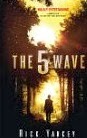
Review of The Fifth Wave by Rick Yancy


Putnam Juvenile

The Fifth Wave
by Rick Yancy
5 Stars!
Ever wonder what it would really be like if Earth were invaded by aliens from another planet? I have, and my imaginings always ram somewhere between the aliens from Tom Cruise’s version of War of the Worlds and Will Smith’s Independence Day. Thankfully, Rick Yancy has a much more realistic and riveting imagination.

Cassie is a little freaked out when the mother ship appears over her neighborhood. But, after a week or so nothing happens so, whatever. Then the lights go out and a few people die in accidents and whatnot because there’s no power. After some more time passes and people are used to seeing the ship in the sky the tsunamis come and devastate the planet, but Cassie is in Ohio, so her family is spared. When the plague comes and infects many around her, she starts to feel real terror, but where are the aliens? Where are the aliens indeed?

The novel is a brilliant and perhaps very realistic imagining of what might happen if a superior race chose to invade and claim our planet, besides being an intuitive study of human behavior. The brilliance of the work is the slow terror that develops through the action; instead of a series of explosions, the story focuses on the psychological toll of a slow, stealthy invasion that confuses and divides. How do you fight a war when you can’t see the enemy or you see them but cannot identify them? How do we band together when every “wave” drives us further and further apart? The story is told primarily through the eyes of Cassie, but also alternates between two other main characters, Evan and Ben, both victims in their own right of the alien invasion but in markedly different ways. It is impossible not to become invested in what happens to all three characters, impossible not to plow through the chapters in order to see how the fates of these three might become later entwined. I was riveted to the story, glued to the idea of children being used as a “vanguard and weapon,” Lord of the Flies style, and amused by the homage (we won’t call it a blatant rip off) to the film Full Metal Jacket via the character of Reznick. Even in such a horrifying tale it seems there is room for—indeed there has to be—humor. Perhaps most enthralling for me were the themes that kept me wondering. How do you face death on a daily basis when there is no hope?  How long can humanity survive in isolation from one another? We are social creatures after all. And lastly, how might an alien force rid the earth of humans? Maybe Cassie, and our own Earth’s history, has the answer, “rid the humans of their humanity.” This is one novel I would be anxious to read a second installment of, but I’m not sure one is needed. This novel stands as a testament to the genius of Yancy, and I for one, recommend it to anyone who is up for a sophisticated, engaging read unlike any that have come before it.

Monday, July 29, 2013

Review of Believe by Sarah Aronson

Carolrhoda Books
Believe
by Sarah Aronson
Released September 1, 2013
2 Stars


While on a trip to Israel when she was six years old, Janine Freeman was the sole survivor of a suicide bomber. Now she is sixteen, and the man who rescued her from the rubble believes that her broken hands have the power to heal. Janine doesn’t believe in God, and she’s tired of the media stalking her and making her a symbol of faith, or the “Soul Survivor.” How will she find peace in a world that won’t let her be the person she wants to be?

For a novel with such bold ambition and monumental themes, the narrative starts slowly and does little to increase speed from there. The prose is choppy and uneven, bordering on distracting. The setting, Bethlehem, PA is a great example of forced irony. And while the character of Lo, Janine’s aunt and adoptive mother, is a strong, insightful character, she alone cannot hold the action of the book. Janine is a shallow character with little to offer that might invest the reader in her fate. She wants to be a fashion designer on her own merit and not because she is a celebrity. She hardly ever ventures into public without scanning her surroundings for paparazzi so she can avoid them.  However, as stated by her best friend, Miriam, Janine doesn’t “want to be famous, but if anyone ever—for a split second—forgets who [she] is and what [she] lived through—[she] makes sure they remember.” If her friends ask a favor of her, she declines or lets them down. If her fashion design teacher offers solid critical advice, she balks. If she is asked to keep a life or death promise, she blabs. Janine is perhaps the most unsympathetic character ever placed in the pages of a book—she rarely admits fault and enjoys criticizing others. What connections she has are superficial. Even her relationship with her boyfriend, Dan, is one-sided. She refuses to show him affection in public, she only mentions him in the book in passing (he only appears in a few scenes), and when Dan breaks up with her, she shows little emotion, only slight confusion. Certainly there have been unsympathetic characters in literature before, but the difference is that these characters usually experience phenomenal growth through the events and tests they face in the story. Don’t get me wrong, the story has tests. Janine faces difficulty and disappointment, but it is unclear how all of these ups and downs shape her character. Maybe the goal of the novel is to show Janine discover humility and faith, and perhaps the author seeks to achieve this through the novel’s ending. Alas, Janine’s change is unconvincing and falls flat—too little too late. The conclusion only slaps an unlikely ending on a more unlikely story.

Tuesday, July 23, 2013

Review of Tell the Wolves I'm Home by Carol Rifka Brunt

The Dial Press
Random House Digital
Tell the Wolves I’m Home
by Carol Rifka Brunt
5 Stars


June loves her Uncle Finn, not just as an uncle, but a best friend, godfather, and her first girlish crush. So when Uncle Finn dies from AIDS June is at a loss about how to deal with the crippling grief she feels—worse, it’s the 1980s and the world is just being introduced to the disease. Even though her uncle is a famous painter, there is a stigma attached to his death. No one seems to understand her loss or even want to talk about it until she meets Finn’s boyfriend, Toby, someone June never knew existed.  Was Toby Finn’s killer, or is he the man who can help to heal June’s heart?
Perhaps one of the reasons I connected with this novel is the fact that it was set during the 1980s. I was a teenager at this time, and I can remember when AIDS was first publicized. AIDS was terrifying, but was largely treated as a “gay” men’s disease, so many teens not only dismissed it out of hand, but mocked the victims. Religious groups saw it as a just reward for immoral behavior, and rural teens just didn’t get it. The GLBT community was very much in the dark in the 1980s—at least in my small town. Who knew that people in my community might have struggled with these issues and with this illness? The novel was enlightening and helped to reveal the struggle many families must have had not only with the disease and its devastating results, but with acknowledging the sexuality of their relatives.  June is a wonderful conduit for the themes in this novel and an endearing character. Her innocence enlightens the reader to the conflicts of the time, and also personalizes Finn and Toby.  June makes Finn and Toby human when others may not see them as sub-human. I felt the family dynamics were very important to the novel as well. I loathed June’s sister, Greta, who I thought was hateful and self-absorbed, and even at the end I wanted to smack her. But Greta is an important character, because she is what she is and June still loves her despite her cruelty and cynicism. Just like every other character in the novel, she is flawed, and yet there is still love in her and she is still worthy of love. June’s parents, her mother especially, show the embarrassment that some felt having gay relatives, and also the narrow-mindedness of forcing relatives to choose between lives. In all, the conflicts were not only real, but tragically so, and beautifully woven to create a snapshot of 1980s life. Looking back from 2013, much has changed, but perhaps not as much as we may imagine. The disease has become more widespread, not a “gay” disease at all, but sadly one that still seems to have badge of dishonor associated with it.  Perhaps the novel helps to reveal those erroneous assumptions about the disease because the truth is AIDS doesn’t discern between color or creed, sexuality, nationality or any other standard—so it’s best to realize that we are standing in its path—flawed, human, and vulnerable. We need one another, and kindness, love, patience and understanding are our best tools of defense.

Thursday, July 11, 2013

Review of Die for Me by Amy Plum

HarperTeen
Die for Me (Revenants)
b
y Amy Plum

4 Scribbles
After the death of her parents, Kate and her sister Georgia move to live with their grandparents in France. Kate swims in depression, struggling to fit into a world without her mother and father, but then one day she sees a boy who catches her attention. Vincent Delacroix is everything a girl could want, handsome, charming, sensitive, and doting. But when Kate finds out that Vincent isn’t a normal teenage boy, she isn’t sure she can stand to love him.

This novel has much in common with the Stephanie Meyer Twilight saga. Girl moves to a new place, Girl meets mysterious sexy guy, Girl meets guy’s entourage and becomes best friends with Charlotte, one of the crew, Girl finds out guy is Undead, and Girl discovers she cannot live without guy. Oh, and guy has seriously dangerous enemies who will target her if they know she loves Vincent.  So, if you are a Twilight fan, you won’t be able to help loving this story. I like Twilight okay, but I’m sort of burned out on the whole vamp genre, so it was nice to see this tiresome formula have a little twist. In fact, I’ve already read the second book Until I Die and downloaded book three which just came out in May, If I Should Die. I seriously think this series will be opted for film. That being said, let’s discuss the strengths and weaknesses of the work outside of the obvious weakness, it’s a ringer for the Twilight formula.  Perhaps best of all is the unique Undeadness that Vincent suffers. He is a Revenant. This means that he has a compulsion to save the lives of humans, and once he dies for someone else, three days later he is resurrected again (we’ll just leave Christian theology out of the discussion of this novel). Thus, he isn’t immune from death, which is why Kate isn’t sure she can love him, I mean who wants to endure the death of a loved one over and over again especially when they’ve recently lost their parents (I mean, if he’s coming back though, what’s the big deal?). I’m not sure I buy that obstacle to their love entirely, but whatever. A better hurdle is the fact that Revenants have sworn enemies, Numa, who would happily destroy Kate if they knew her importance to the clan, and the fact that her wonderful grandparents would not like her dating a Revenant.  So those conflicts are well done. The characters in this novel are a huge plus. Kate isn’t especially interesting to me (perhaps because she’s a bookworm like me) but her sister Georgia is amazing and fun and quirky, and I adore the crew that Vincent rolls with.  Kate’s grandparents are classy and cultured, and that’s pretty cool. And of course, the author has so many opportunities to elaborate on the history of each character layers and layers of interest are added to the already great mystery of the story line. I also admire the way the author deals with the age issue between Vincent and Kate. I was always bothered by the fact that Bella in Twilight is dating, essentially, an old man, which makes Edward sort of a pedophile.  However, in this novel, Vincent returns to the age he was when he died, each time he rescues someone. So he is only a few years older than Kate. This is drilled into the reader by repeated pronouncements of Revenant’s ages. So, even if I might still be a tad skeptical, the author artfully brushes that concern aside, thus making the kissing scenes less, um, disturbing. Lastly, the novel is set in Paris, France. Who doesn’t want to know more about France? And if you listen to the book on audio like I did, even better. Then you get to hear the sexy French accents. So those of you YA paranormal romance lovers who like a little who-dun-it action in the mix, check this one out, you’ll be hooked!

Wednesday, April 17, 2013

Review of The Genius of Little Things by Larry Buhl

CreateSpace Indepedent
Publishing Platform
The Genius of Little Things
b
y Larry Buhl

3 ½ Scribbles


Tyler Superanaskaia (it’s Russian) has spent the years since his mother’s death in foster care, or the “foster-go-round” as he calls it. Now Tyler is approaching graduation and that means starting his life post-foster-system exactly the way he’s always dreamed it: living on his own, attending Caltech and becoming a successful immunologist. Yet, in order to achieve these dreams, he must first earn money for his future living expenses, write an award-winning admissions essay and present an academic record that will earn him a scholarship. Will Tyler’s quirky personality and peculiar sense of “normal” get in the way of his dreams?

Told in a series of Tyler’s amusing lists, botched admissions essays and narration, the novel is carried largely through the strong sense of voice permeating each page. Tyler’s character is eccentric to say the least; his is so analytical that it is difficult for him to come down to the level of those who are less intelligent but more streetwise. He uses extremely advanced vocabulary when it is unwarranted, and he is so literal that he often misses the meanings of euphemisms—and yet, he has very clever and ironic nicknames for key people in his life. For instance, he calls his current foster parents, Carl and Janet “FoPas.” At times this dichotomy is confusing to the reader, at other times it is indicative of a touch of Asperger’s Syndrome or at the very least a symptom of living in homes that serve to isolate him from healthy, positive socialization. As it stands, this distinction is not made but left to the reader to determine. Nonetheless, this strange character dynamic does not limit the humor in the story. More sophisticated readers will enjoy Tyler’s ironic musings, his clumsy relationship with Rachel, and his disastrous and hysterical attempts at creating stronger extra-curricular experiences for his resume. In short, they will stand firmly in Tyler’s corner. Minor characters in the story provide interesting compliments to Tyler’s struggle, showing that all individuals have battles of their own, from Carl and Janet, whose marriage is struggling in the wake of their son’s death, to Levi, whose uber-religious parents hold him in chains.  The only problematic element in the story is Tyler’s flippant reaction to Milagro’s death; his lack of concern is clearly caused in part by his short-lived, yet disastrous use of drugs. And perhaps in reality this is what happens—drug abusers sometimes don’t suffer consequences to their actions or recognize how their actions affect others—but such imperviousness on Tyler’s part does not ring true with the Tyler who is developed throughout his time working at the nursing home, the Tyler who falls in love with Rachel and the Tyler who reaches out to Levi. But for this one odd puzzle piece, I’d have given this novel a full four scribbles. Readers who enjoyed such novels as The Perks of Being a Wallflower by Stephen Chbosky and Looking for Alaska by John Green should definitely check out this novel, by screenwriter and playwright Larry Buhl.

Monday, February 18, 2013

Review of Hysteria by Megan Miranda

Walker Children's
Hysteria
by Megan Miranda

4 Scribbles


When Mallory kills her boyfriend Brian in self-defense, her childhood ends. Although she is found innocent, Mallory quickly becomes a social pariah. She is suspected of dishonesty by most in her community and deemed a brutal killer by others, but no one judges Mallory more harshly than she judges herself.  Hoping to escape the haunting memories of that night, Mallory transfers to her father’s alma mater, the elite prep school Monroe, where she can start afresh.  Yet, her past continues to haunt her. And when Mallory is blamed for another untimely death—she begins to wonder what is real and what is “hysteria.”
Although a main thread in the novel is Mallory’s tentative grasp on reality, a constant feeling that she is either being haunted or may be experiencing a sort of psychological hysteria, the tone of this story could not be more real. This sense of the real is the main strength of the novel. So many times when characters die in literature, their death is treated as a novelty, an aside, a fact from the past to be greeted with mild interest at best and with apathy in most cases. Through Mallory’s eyes, the reader begins to grasp the impact of the death. The reader feels what it would be like to take the life of someone else, even in self-defense. They smell the blood, hear the gasps of the dying, sense the spirit leaving the body, stand beside the cold corpse. The reader understands the doubt, the guilt, the second-guessing that victims must go through in the aftermath of such an event. They see the tendency of bystanders to blame the victim. Ironically, Brian becomes a living, breathing person through the haunting that Mallory experiences. Equally realistic is the development of Mallory’s character from a typical, ornery teenager who isn’t above a little manipulation, interested in boys and fun, to the brooding, guilt-written young woman that she becomes. And this transition is not limited to Mallory.  In the space of one evening, she and her best friend Colleen, who shares a bond with Mallory beyond sisterhood, must suddenly “[say] good-bye….To the future…Even if…the future was just tomorrow.” Unlike many of us who experience this transition into adulthood slowly, these characters are not so fortunate. The novel is a sophisticated read to be sure, with a tone and tension (and alas even a line) borrowed from Poe himself, and it is this tone that lends suspense to the work. While less ambitious readers may find the beginning of the novel slow, more advanced readers will appreciate Miranda’s skill. The subtle use of foreshadowing, well-placed flashbacks, superior character development, and the intricately woven mystery will be a treat for these readers who will undoubtedly find themselves engrossed (as I was) from beginning to end.

Wednesday, January 9, 2013

Review of Timekeeper (Book 2, Timeless) by Alexandra Monir

Delacorte Books 

Timekeeper (Book 2, Timeless)
Alexandra Monir
3 Scribbles 

Michele barely has time to register that the new guy at school looks exactly like Phillip Walker, her beloved Gilded Age boy, when a ghostly woman in black appears. Worse, it seems the menacing woman is stalking her. Phillip promised he would find a way back to Michele so that they could be together; why does he avoid her now?  And does this dark, sharp-eyed woman have something to do with that? Using her father’s time-traveling key and diary Michele must discover the reason for the woman’s increasing presence—otherwise, Michele’s time to be with Phillip may run out all over again.
The intense relationship between Michele and Phillip introduced in book one is somewhat overshadowed (no pun intended) in book two by the appearance of the mysterious woman in black. But readers will find this a good thing because her appearance in the series adds a welcome tension and yummy spook factor; this, combined with time-crossed romance between Michelle and Phillip, makes for a conflict-filled and engaging read. As in book one, the time travel is very well written; the plot leaps between the decades from 1885 to the year 2010 seamlessly—the reader never gets confused about what period they are in even though they may jump a century within a few pages. New York City is so well described in the Gilded Age and the World War II era that I spent time online looking at old photos of NYC. When a book pulls me in that far, well….let’s say I’m hooked. I do have a little issue with how quickly Michele seems to accept her father, how quickly Michele connects with people overall really, and the loose ends in the novel are a bit too conveniently wrapped up in my opinion, but the readers who enjoyed book one, and those who love time travel sagas, are going to enjoy this installment.

Tuesday, January 8, 2013

Review of Timeless by Alexander Monir

Random House
Children's Books
Timeless (Book 1)
Alexandra Monir
3 Scribbles

Michele Windsor is just like every other teen aged girl—that is until tragedy strikes. Now her world is turned topsy-turvy; she has been transplanted from California to a posh mansion in NYC, is heir to the throne of the great Windsor legacy (and millions), and is meeting her grandparents for the first time.  And it doesn’t take Michele long to realize that her grandparents are keeping something secret from her; she’s determined to discover what that secret may be. Little does she know that her snooping will uncover a century-old diary, a key, and the ability to travel back in time—where the love of her life awaits.

Writing novels in the first person present tense seems to be a trend, so it was a bit jarring at first to read a novel told in the third person.  However, after a brief period of adjustment, I began to sink into the story line, and I found that the narration works. Happily, this is anything but a rags-to-riches tale. Not only does Michele not care about her newly inherited fortunes (refreshing), she is mainly focused on connecting with another human being. I liked this aspect of her character very much, even if I found her sudden romance with Phillip Walker, the young gentleman from the turn of the century Gilded Age, rather quick to develop. But perhaps there are souls that recognize one another and are inherently matched? I suppose that love at first sight is less difficult to swallow than the possibility of time travel, yes? At any rate, while I appreciated that Phillip and Michele were meant to be together, what I really liked about the story was the time travel. It’s phenomenal how Monir manages to keep all the back-and-forth events in order without missing a beat, and I adored learning more about New York City, and the events and culture of the United States during that period through Michele’s modern eyes. The novel was fun, and I am glad that book two, Timekeeper, is being released today!

Friday, December 7, 2012

Review of Days of Blood & Starlight by Laini Taylor

Little Brown Books for
Young Readers
The Days of Blood & Starlight (Bk. 2 Daughter of Smoke and Bone)
By Laini Taylor
5 Scribbles

No one builds worlds as well as Laini Taylor—well not since Tolkien anyway. And now that Karou knows who she truly is, she is plunged headfirst into the broken world of her people, the chimaera. Filled with vengeance and righteous anger, Karou chooses to join her people in the fight against the angels—and against Akiva—in a crucial role.  But is her choice to turn her back on love worth it?

The characters in this novel are even more lifelike and vivid than in the first. It is easy to become immersed in the world of Elsewhere while reading about wolves, Naja, Kirin and winged creatures designed by Karou’s artistic hand. From Thiago’s glossy white fur and menacing eyes, to Ziri’s lithe, antelope-human body, to Akiva’s special beauty and glowing red wings, the reader is treated to a kaleidoscope of images that become virtual candy for the imagination.  And if the descriptions of the creatures and the world of Elsewhere don’t captivate the reader, then the bloody conflict certainly will. Karou and Akiva, soul mates and lovers in book one, find themselves as sworn enemies in this second installment. For Karou, this means filling Brimstone’s shoes as the new Resurrectionist and trusting Thiago, the wolf she still hates with all her being, but must follow to avenge the deaths of her people. It is a strange situation that places Karou as a sort of voluntary prisoner and amplifies the fact that the need for vengeance now controls her. Akiva, on the other hand, is ready to make amends to Karou, and to cease his killing ways, because “a drop of mercy dilutes a lake of hate.” And while there is truth in this, Karou has not had the benefit of years to heal that brought Akiva to this conclusion—thus, she has sworn to hate him.  How much will Karou be willing to endure, and how many angels will she have to kill in order to find any semblance of peace? And if both sides can come to some peace, will the physical marks of Hamas and tattoo marks of the slain on the angels’ hands, be too much of a reminder of atrocities past for the opposing sides to accept one another?

While the conflicts are heavy, bloody, and battles constant, some comic relief is thankfully present via Karou’s BFF Zuzana, now hooked up with Mic from book one. The two provide welcome foils to the newly-sworn-enemies-once-lovers Akiva and Karou. Zuzana and Mic also show an ironic tolerance for the strange creatures and help illustrate the power of music and kindness on the human (and not so human) soul. Perhaps most importantly, these two characters keep the story grounded, and add a human element to the second book which hints at the idea that humans may play a critical role in book three which I am anxiously awaiting…

Wednesday, December 5, 2012

Review of The Dead and the Buried by Kim Harrington

Point
The Dead and the Buried
by Kim Harrington
4 Scribbles
To be released January 1, 2013

Jade never dreamed she’d live in a big house in an upscale neighborhood, and she’s overjoyed when her dad and stepmom move the family, even if she knows it’s really so her baby brother, Colby can have a better education than she did. But then Jade discovers the things that go bump in the night. Turns out, there is a reason the house was such a good deal. Local “it” girl Kayla Sloane was pushed down the stairs to her death in the house just the year before. Now, Kayla’s ghost is threatening to kill her baby brother unless Jade finds Kayla’s murderer.

Realistic characters and spine-chilling events make for a truly creeptastic read!  Jade feels like an outsider in her family now that her father has remarried, a situation many teens can relate to.  Jade misses her mother, who taught her the metaphysical powers of gemstones. Without her beloved mother, who died of cancer, Jade has no idea who to trust with her stories of Ouija boards and threatening specters, and she’s pretty sure her stepmother will think she’s crazy. Add to this the fact that her dad is always traveling for work and Jade feels alone and helpless. But Jade loves her brother, Colby and is willing to risk anything to save him. Perhaps the most refreshing thing about Jade is that she picks friends based on integrity and not popularity, even though she is tempted to choose poorly in order to “fit in” to her new school. Secondary characters, like Kayla’s brooding ex, Donovan (who makes for a tantalizing love interest), and Jade’s quirky, anti-social friend Alexa add a feeling of diversity and realism to her new school, and also create doubts about who Kayla’s true killer might be. I also liked that Kayla was such a hateful girl and didn’t change after death; sometimes people are just rotten, and dying does not change that, no matter how much people pretend it does.  This mystery is incredibly solid, with clues gleaned from Kayla’s cryptic diary and frequent episodes of haunting and possession that chill the marrow.  Readers who grove on shows like Ghost Hunters and Paranormal State will love this book!

Wednesday, November 28, 2012

Review of The Fault in Our Stars by John Green

Dutton Juvenile
The Fault in Our Stars
by John Green
5 Scribbles

Hazel is a grenade. She lives under the constant pressure that any day could be her last. She has terminal cancer held in check by experimental drugs—cancer that will eventually explode and destroy her weakened body. Hounded by her parents to be more active, Hazel meets cancer survivor Augustus Waters in a weekly support group, and soon the two teenagers are on the verge of something more than friendship; yet, Hazel doesn’t want to be loved, not when at any moment her cancer may ignite, and those loved ones she leaves behind will be forced to pick up the pieces.

Only John Green can take two teenagers whose entire lives, whose circle of friends, whose very experience of life revolves around cancer—and make it funny.  For the first half of this marvelous novel I chuckled at the quirky dialogue and quips exchanged between Hazel, Augustus and their friend Isaac, and enjoyed the cynical sense of humor shared by these three cancer victims. Despite their weekly visits to the “literal heart of Jesus” where they listen to a social worker discuss his earlier bout with testicular cancer (insert ball jokes here) the three seem to have an incredibly positive and realistic outlook on life.  Imagine going to a meeting every week where you are reminded of your mortality, given a list of the recently deceased children who’ve gone before you, and generally soaked in the presence and culture of death. How many of us could smile, let alone laugh? As the story develops and through the voices of Hazel and Augustus, who clearly love one another but fight the attraction, we meet Peter Van Houten, author of Hazel’s favorite novel, An Imperial Aflliction.  It is Van Houten’s work, his voice, who in many ways bring the two “star crossed” lovers together. In fact, it is Van Houten who first points out that that the fault of a future that “sucks” may have nothing to do with us, or our choices. Sometimes fate decides. Good people have bad luck, young people get sick and die. It happens. The fault is not in ourselves (a reference to lines from the Shakespearean play Julius Caesar), it really is in our stars. This honesty is what makes the novel so tragically wonderful, so incredibly moving, and the unexpected twist so heart wrenching. And yet for each tear I shed in the novel, I laughed twice as much. And isn’t that really what life is supposed to be about, no matter how brief that life might be?

Wednesday, October 17, 2012

Review of Copper Sun by Sharon Draper

Antheneum Books for
Young Readers
Copper Sun
By Sharon Draper
5 Stars

Imagine your whole world and everyone you love disappearing in an instant. You are beaten and dragged away in chains. How would you feel? What would you do? This is Amari’s fate when her village in Africa is visited by strange-looking men the color of “goat’s milk.” At first, the villagers are excited to host a welcome celebration. But their joy is cut short when the celebration turns into a savage and deadly attack. Amari suddenly finds herself shackled and driven on a march to the sea where she is branded and taken aboard a ship, never to see her homeland again. She is now a slave, and her future holds nothing but misery, anguish and grief, unless she can escape.

Perhaps too many Americans think of slavery as a thing of the past, and not the Holocaust that it was—the genocide and enslavement of a people. But through Amari, a character who is far from flat or cliché, the reader can relate to the suffering and loss of the slaves who built America with their blood and tears. Amari is so real, so gentle, and so innocent, that it is hard not to instantly become invested in her fate.  But it isn’t just Amari who makes the story interesting. Each character in the story contributes a perspective to this woeful tale that is different but historically significant. For instance, white characters are not a stereotype. They each represent the perspective of a community that made slavery happen. Even the “kind” whites like Sailor Ben, who occasionally takes mercy on Amari, or indentured servant Polly, who could care less for negroes but comes to sympathize with Amari, or Doctor Hoskins, who like so many whites opposes slavery but remains a bystander and does nothing to prevent the abuse, all share guilt for the deaths of many thousands of slaves. Villians like slave-owners Percival and Clay Derby who are on the front lines of purchasing slaves bring the cruelty of the institution to life even when they aren’t being directly cruel.  Each of these characters, and their historical counterparts, allowed their prejudice and self-preservation to stand in the way of humanity. Even African characters, like the Ashanti who betray Amari’s village, bear guilt for slavery—no angle is left unexamined. Draper truly reveals the complicated social ramifications of the slave trade in a way that other novels do not.

The novel is very well researched. Readers will be shocked to know that slaves in the field rarely lasted more than five years before they died and were replaced, or that the knowledge of slaves often far exceeded the expertise of the master. Perhaps most disturbing is the number of slave women who were raped by masters and other whites with power over them. Yet, despite its gritty detail and shocking truths, the story is as easy to understand, exceedingly interesting, and accessible for readers who struggle.

Thursday, October 11, 2012

Review of Where Things Come Back by John Corey Whaley

Antheneum Books for
Young Readers
Where Things Come Back
By John Corey Whaley
2 Scribbles

Since this novel has received so many awards, and since it is narrated in the voice of a teenager stuck in a small town, I was excited to read it. I grew up in a small town and couldn’t wait to escape it! And while I will say that Whaley does capture the feeling of cynicism felt by many teenagers stuck in small towns who have little vision of the future, that feeling of cynicism is pretty much the only thing I could identify with in the novel.

The story is told mainly through the eyes of Cullen, a bored teenager who works at a local convenience store and hangs out with his friends. Cullen and his crew are amused by the current excitement in their hometown, Lily, over the possible reappearance of a long-extinct species of bird named the Lazarus Woodpecker. Alternating chapters are told in third person and describe the lives of Benton, raised to be a missionary by his dictatorial and overly-zealous father and Cabot, college-boy player extraordinaire turned nutcase. Eventually, the bizarre connection between the three narratives becomes clear.

Although the author skillfully weaves truisms into the dialogue that I appreciate as insightful, usually through the words of Cullen or Gabriel, I still have difficulty identifying with characters in the novel. Gabriel’s character is too briefly seen, Lucas and his girlfriend are ever-present, but have little to say, and reading about Cullen is, in the words of his own mother, “like watching someone with multiple personalities.” Even Ada and Alma, Cullen’s female companions for lack of a better description, are barely distinctive—not only do their names have similar meaning—but they both take advantage of Cullen and have little interest in him as a person. In short, the characters are very flat, and none of them (with the exception of perhaps Cabot) are particularly dynamic. Perhaps Whaley is attempting to write a modern Holden Caulfield, and indeed the text does have a literary edge to it, but Cullen is no Holden. The symbol of the Lazarus Woodpecker is a bit over-the-top, and frankly the symbolism of many of the names, for instance Gabriel, while perhaps necessary to incorporate the religious zeal, are overstated. Let’s face it, most teens just want a great story, one they can connect with, one they feel accurately reflects issues and concerns in their own lives, and one that moves. Perhaps teens may connect with Cullen’s feelings of negativity and isolation, but only if they can continue past the first few chapters. Couple the dragging plot with the dull cover, and without those award winning stickers, I doubt teens would pick up this novel, let alone finish or applaud it. Perhaps Whaley’s work would be more appropriate for older readers with more patience to trudge through the heavy handed symbolism and bizarre circumstances that bring this work to its completion.  

Friday, September 21, 2012

Review of Hero by Mike Lupica

Puffin
Hero
by Mike Lupica
2 Scribbles

Let’s face it, the closest thing to a sport I will ever take part in is a race to the bestseller shelf at Barnes. Yet, I love how Mike Lupica can take a subject that would typically put me to sleep, like baseball and football, weave it into a cast of awesome characters, and keep me riveted to the action. The novels, Heat and Million Dollar Throw captured me for that reason, and it is because of those novels that I chose to read Hero. Sadly, however, Hero didn’t keep me nearly as glued as the others.

Zach’s dad is something of a hero, he’s the president’s right-hand man, scares the bejesus out of “The Bads” (or bad guys) and has the love of everyone around him—especially Zach—who doesn’t get to see his dad nearly as much as he’d like.  When Zach’s dad dies in a plane accident, Zach and his family are stunned, but Zach is more stunned when he discovers that his father had a secret, and now it’s up to Zach to discover what that secret was and what it has to do with Zach. Chapter one begins with butt-kicking action, but then the action slows instantly.  Zach and his friend Kate live in New York City, the city that never sleeps, and yet I was finding myself hard-pressed to stay awake while Zach explores first the plane crash site, and then the park in search of answers. Even when Zach encounters trouble and has to fight for his life, the action slows immediately after each conflict, making the story’s momentum stagger. Couple that with the fact that each conflict is followed by long, suggestive conversations between Zach’s “Uncle” John and the mysterious Mr. Herbert, and it can be easy for even the most motivated reader to stay invested in the outcome. Too little information is provided as the story moves on, and frankly, the identity of the villain and the good guy are a little too easy to figure out.  The best part of this story is Kate’s tough-as-nails attitude, and reading about what living in New York City is like for the well-to-do.  Overall, I prefer Lupica’s previous efforts.